Sleep from one to five
The nap disappears, bedtime turns into a negotiation, and some children start screaming an hour after lights out. Most of this is ordinary development. A few things are worth a doctor's attention. Here is how to tell them apart.
How much sleep children actually need
One to five is not one age group. A 14 month old and a five year old have almost nothing in common except the label. These ranges come from the American Academy of Sleep Medicine, and they include naps.
Aged 1 to 2
Across 24 hours, naps included. Most children this age are down to one nap, usually after lunch.
Aged 3 to 5
Across 24 hours. From age three the guidance stops assuming there is a nap at all.
Why they are so wide
Children the same age genuinely need different amounts. What matters is whether your child wakes rested and gets through their day.
Bedtime battles are the most common problem at this age
Trouble settling, and waking often in the night, affect somewhere around 20 to 30 percent of toddlers and preschoolers. It is rarely about defiance.
Part of it is a body clock problem, and almost nobody mentions it. Your child cannot fall asleep until their own melatonin has started to rise, which in preschoolers happens at around twenty to eight in the evening on average. In one study of 49 children aged three to six, nearly one in five were being put to bed before their melatonin had risen at all. Those children took longer to fall asleep and resisted bedtime more. They were not being difficult. They were not sleepy yet.
A child who lies awake and calls out is often not refusing to sleep. They are not yet able to.
So the answer is often not an earlier bedtime, it is a bedtime that matches your particular child. If yours lies awake for 45 minutes and then starts calling out, moving bedtime twenty minutes later can work better than moving it earlier.
The other half is routine, and here the evidence is unusually practical. Across more than 10,000 families in 13 countries, a bedtime routine on five or more nights a week went with an earlier bedtime, falling asleep faster, fewer night wakings and more sleep overall. Consistency mattered more than what the routine contained.
Behavioural approaches do work in the short term. Across 52 studies, 82 percent of children improved. If you have read that these methods harm children, the trial evidence does not support it. The one trial that measured stress hormones found cortisol went down rather than up, and a five year follow up found no lasting harm, and no lasting benefit either.
The nap is going to go, and there is no schedule for it
Two naps become one somewhere between 12 and 24 months, most often around 15 to 18 months. The last nap goes somewhere between two and five years. Beyond that, the honest answer is that there is no timetable.
- The most useful number here is not an average. Across 44 studies, the share of three year olds who had stopped napping ranged from about 5 percent to 65 percent. At five years it ranged from 37 percent to 96 percent. That is the real spread of normal.
- Naps get shorter before they stop: about 2.3 hours at one to two years, 1.9 at two to three, 1.5 at four to five.
- Napping is linked to a later bedtime and a slightly shorter night, more so after age two. That evidence is all observational and was graded low quality by the researchers who reviewed it.
- The effect is small: about 16 minutes later to fall asleep for every hour later the nap ended. Total sleep across the full 24 hours was actually higher on nap days.
- When the nap ends matters more than how long it was. A nap that finishes late pushes bedtime late.
- Missing a nap has a real cost on the day. Children who still nap are more easily frustrated when they skip one.
- Sleep does not beget sleep. We could find no primary research behind that phrase, and the studies that measure naps against night sleep point the other way.
- You do not need to end the nap to fix bedtime. Any effect is likely to be 15 to 20 minutes, not an hour.
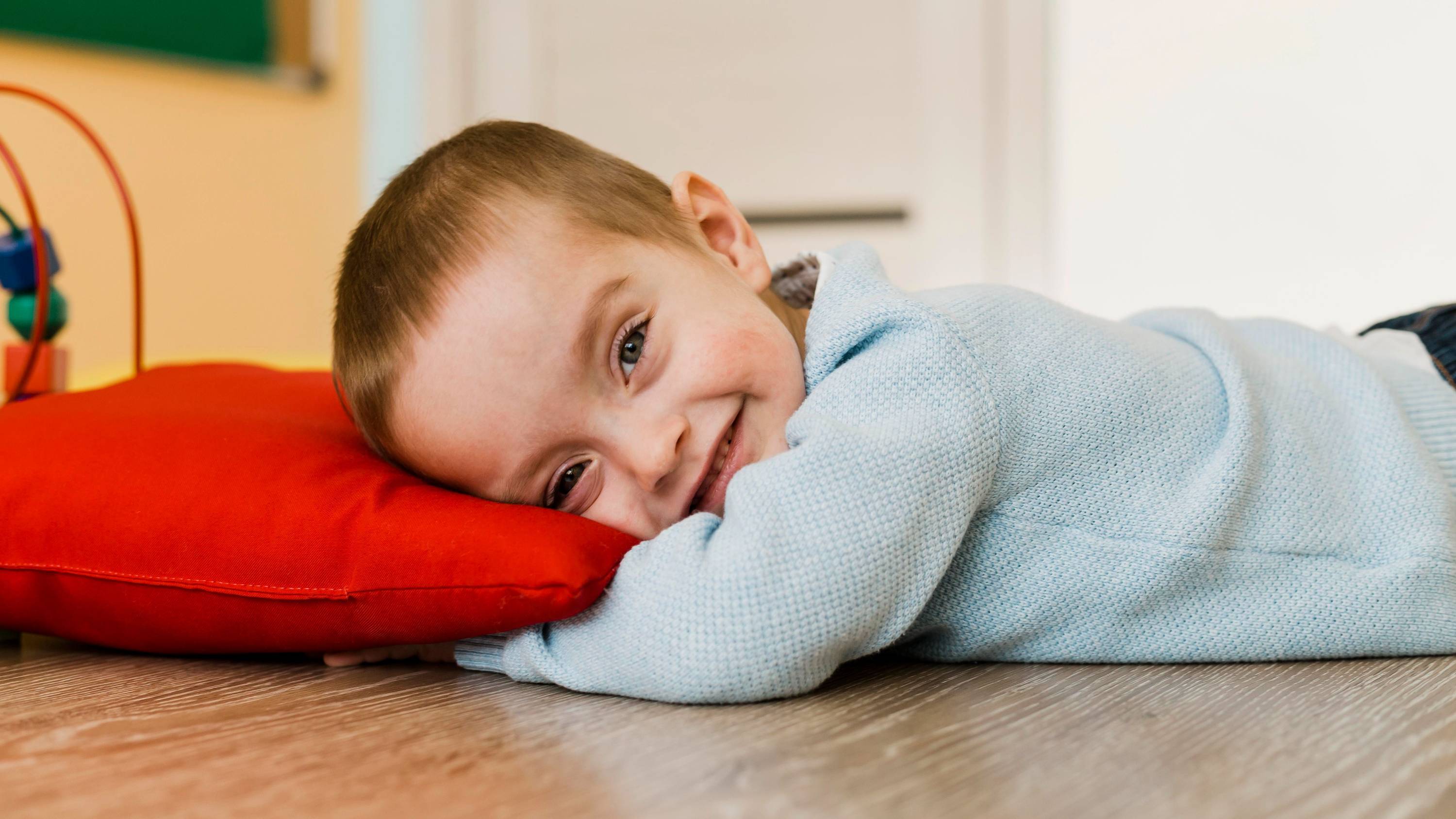
When the nap goes, keep the quiet time
Children stop napping at different ages, and there is no fixed point where it should happen. Holding a quiet hour in the same spot each afternoon keeps the day predictable while the change settles.
Screaming an hour after bedtime
Your child sits up, screams, does not seem to know you, cannot be comforted, and remembers nothing in the morning. That is a sleep terror, and it is far more common than most parents are told.
In a study that followed nearly 2,000 children, a third of 18 month olds had sleep terrors. By five years it was 13 percent. Sleep talking is close to universal at this age, and sleepwalking affects around 15 percent.
These events come out of deep sleep, which is packed into the first third of the night, so they usually happen 60 to 120 minutes after lights out. Nightmares are different. They come later in the night, your child wakes up properly, remembers it, and can be comforted. During a sleep terror, trying to wake or hold your child often makes it last longer.
This is not caused by anything you did. It runs in families. Sleepwalking occurred in 22 percent of children where neither parent had sleepwalked, 47 percent where one had, and 62 percent where both had.
What helps is enough sleep, a regular schedule, a safe bedroom and stairs, and treating anything that keeps breaking sleep up, snoring most of all. In one clinic study, 61 percent of children with troublesome sleep terrors or sleepwalking had another sleep disorder, almost always a breathing problem.
- Events that are brief, identical each time, and come in clusters several times a night
- Stiffening, arching, or bicycling legs
- Your child seeming aware during the event, or remembering it clearly
- Events at any hour rather than the first part of the night
- Any injury, or leaving the house
- Snoring alongside the episodes
- Episodes getting worse rather than fading as your child grows
Screens, light, and the hour before bed
Keep screens out of the hour before bed. That advice is reasonable. The reason is probably not the one you have heard.
Blue light is not really the story. Young children's body clocks are extraordinarily sensitive to evening light of any kind. In 36 children aged three to five, one hour of light before bed suppressed melatonin by an average of 85 percent, and it made almost no difference whether the light was dim or bright across a thousandfold range. The same researchers found the body clock shifted later by an average of 56 minutes. Adults need far more light for the same effect.
So the change worth making is not a screen filter or night mode. Those change the colour of a screen without reducing how bright it is, and studies have not found them to help. The change worth making is a dimmer evening: lower lamps, fewer overhead lights, and a darker room in the last hour.
It is also worth being honest about size. Across studies covering more than 60,000 children under five, more screen time went with slightly less sleep, roughly eight fewer minutes for each extra hour. Screens are not stealing hours from your child's night.
Timing looks worse than total amount, and content looks worse still. In a trial of 565 children aged three to five, swapping violent and age inappropriate programmes for gentler ones reduced sleep problems without reducing total screen time at all.
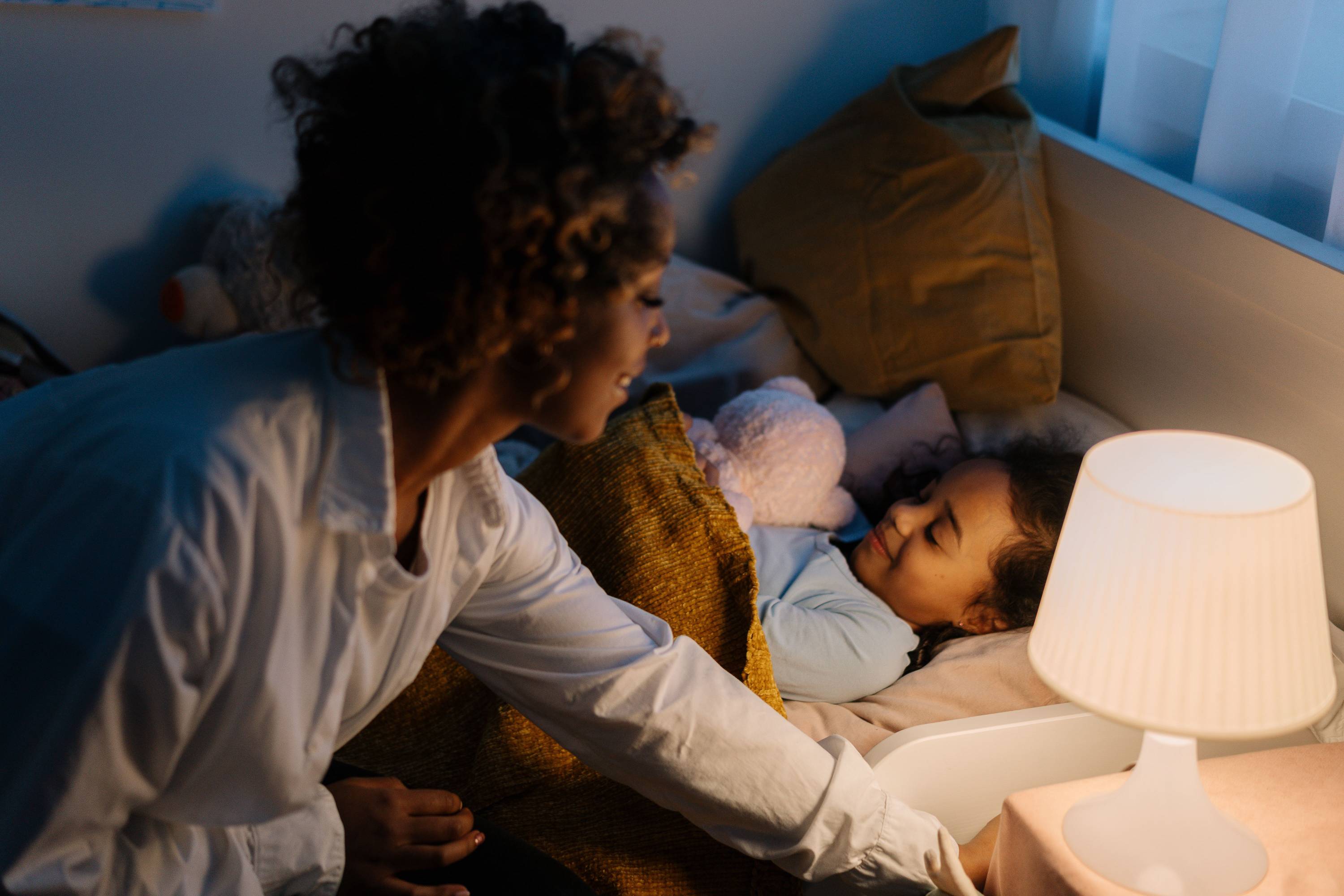
Make the last hour dimmer
Lower lamps, fewer overhead lights, and a darker room help a child wind down. What is on the screen matters as much as how long it is on.
Snoring, and when it matters
About 7 in 100 children snore most nights. Only a small fraction of them have obstructive sleep apnea. Both of those facts matter, and most advice gives you only one.
This is the age when snoring is most likely to signal a problem, though not for the reason usually given. Tonsils and adenoids do not reach their largest size until seven to ten years. What peaks now is the ratio of that tissue to a small airway, and the space behind the nose is narrowest at around four and a half.
Four things are worth telling your doctor about: loud snoring most nights, pauses or gasping, breathing through the mouth while asleep, and restless sleep with unrefreshing mornings. In young children, being short of sleep often shows up as being wired rather than sleepy. In one study, snoring in early childhood predicted hyperactivity four years later.
What you cannot judge by looking is how serious it is. In a large trial, everything a clinician can assess in a clinic room, tonsil size included, explained less than 3 percent of the difference in severity between children. That is what an overnight sleep study is for, and at this age there is no reliable home version.
If surgery comes up, here is the honest picture. Removing the tonsils and adenoids reliably improves breathing, symptoms, behaviour and quality of life, but in two large trials it did not improve tested thinking and attention. In a real world group of 578 children it cleared the apnea completely in only 27 percent, and older or heavier children did least well. In younger, lighter, otherwise healthy children it is closer to three quarters. Worth asking your surgeon which group your child is in.
Children with Down syndrome are a separate case. Almost every preschooler with Down syndrome has some degree of sleep apnea, and symptoms track poorly with what a sleep study finds, so a sleep study is recommended by age four whether or not anything looks wrong.
Snoring most nights is worth mentioning
Loud snoring most nights, pauses in breathing, or mouth breathing during sleep are all worth raising with your own clinician. A few notes from home help more than one night in a clinic.
Worth mentioning at your next visit
None of these means something is definitely wrong. They are the things worth saying out loud, because they are easy to miss from the outside and often straightforward to treat.
- Snoring most nights of the week
- Pauses in breathing, gasping, or choking sounds
- Breathing through the mouth while asleep
- Restless sleep with unrefreshing mornings
- Hyperactivity or trouble concentrating that gets worse when sleep is worse
- Taking more than 30 to 45 minutes to fall asleep, most nights
- Leg discomfort at bedtime, or a strong urge to move the legs
- Night events that are brief and identical each time
- A child with Down syndrome who has not had a sleep study by age four
Write down what you are seeing, how often it happens, and how long it has been going on. A few specifics from home are more useful than one perfect night in a clinic.
This page is education, not medical advice, and it cannot diagnose your child. Please talk with your own pediatrician or family doctor about anything that concerns you.

OWL magazine, Owlkids
The Sleep Health Organization in the Insider section, on why having trouble falling asleep is common.
Dr. Anya McLaren-Barnett is one of the physicians behind this health resource for families, written by Black providers.
Have another child at a different age?
What is normal at two is not normal at seven. Pick the age closest to your other child.
Where this comes from
- Paruthi S, et al. Recommended amount of sleep for pediatric populations: a consensus statement of the American Academy of Sleep Medicine. Journal of Clinical Sleep Medicine, 2016. Source of the 11 to 14 hours and 10 to 13 hours figures.
- World Health Organization. Guidelines on physical activity, sedentary behaviour and sleep for children under 5 years of age, 2019. Source of the change in wording about naps at age three.
- Mindell JA, et al. Behavioral treatment of bedtime problems and night wakings in infants and young children. Sleep, 2006. Source of the 20 to 30 percent estimate and the 82 percent improvement figure across 52 studies.
- Hartstein LE, et al. The relationship between circadian phase and sleep timing in preschool-aged children. Journal of Biological Rhythms, 2026. Source of the finding that nearly one in five children were put to bed before their melatonin had risen.
- LeBourgeois MK, et al. Dissonance between parent-selected bedtimes and young children's circadian physiology influences nighttime settling difficulties. Mind, Brain, and Education, 2013. Source of the average melatonin onset time and its link with settling difficulty.
- Mindell JA, et al. Bedtime routines for young children: a dose-dependent association with sleep outcomes. Sleep, 2015. Source of the five or more nights a week finding.
- Gradisar M, et al. Behavioral interventions for infant sleep problems: a randomized controlled trial. Pediatrics, 2016. Source of the cortisol and attachment findings.
- Price AMH, et al. Five-year follow-up of harms and benefits of behavioral infant sleep intervention. Pediatrics, 2012. Source of the finding of no lasting harm and no lasting benefit.
- Staton S, et al. Many naps, one nap, none: a systematic review and meta-analysis of napping patterns in children 0 to 12 years. Sleep Medicine Reviews, 2020. Source of the nap cessation ranges and the nap duration figures.
- Thorpe K, et al. Napping, development and health from 0 to 5 years: a systematic review. Archives of Disease in Childhood, 2015. Source of the association between napping and later, shorter night sleep, and of the low quality grading.
- Reynaud E, et al. The interplay between nap and nighttime sleep in preschool-aged children. BMC Public Health, 2026. Source of the 16 minute and 14 to 19 minute figures, and of the higher 24 hour total on nap days.
- Petit D, et al. Childhood sleepwalking and sleep terrors: a longitudinal study of prevalence and familial aggregation. JAMA Pediatrics, 2015. Source of the sleep terror percentages by age and the family history figures.
- Petit D, et al. Dyssomnias and parasomnias in early childhood. Pediatrics, 2007. Source of the sleep talking and sleepwalking percentages for children aged two and a half to six.
- Guilleminault C, et al. Sleepwalking and sleep terrors in prepubertal children: what triggers them? Pediatrics, 2003. Source of the 61 percent figure. This was a small clinic study without a control group, so read it as a reason to check for snoring, not as proof that treatment cures sleep terrors.
- Hartstein LE, et al. High sensitivity of melatonin suppression response to evening light in preschool-aged children. Journal of Pineal Research, 2022. Source of the 85 percent melatonin suppression figure and the absence of a brightness effect.
- Hartstein LE, et al. Evening light intensity and phase delay of the circadian clock in early childhood. Journal of Biological Rhythms, 2023. Source of the 56 minute delay.
- Janssen X, et al. Associations of screen time, sedentary time and physical activity with sleep in under 5s: a systematic review and meta-analysis. Sleep Medicine Reviews, 2020. Source of the small overall association.
- Przybylski AK. Digital screen time and pediatric sleep: evidence from a preregistered cohort study. Journal of Pediatrics, 2019. Source of the eight minutes per hour figure.
- Garrison MM, Liekweg K, Christakis DA. Media use and child sleep: the impact of content, timing, and environment. Pediatrics, 2011. Source of the finding about media use after 7 in the evening.
- Garrison MM, Christakis DA. The impact of a healthy media use intervention on sleep in preschool children. Pediatrics, 2012. Source of the content trial in 565 children.
- Pickard H, et al. Toddler screen use before bed and its effect on sleep and attention: a randomized clinical trial. JAMA Pediatrics, 2024. Source of the pre-bedtime screen removal trial.
- Lumeng JC, Chervin RD. Epidemiology of pediatric obstructive sleep apnea. Proceedings of the American Thoracic Society, 2008. Source of the 7 in 100 habitual snoring figure.
- Marcus CL, et al. Diagnosis and management of childhood obstructive sleep apnea syndrome. Pediatrics, 2012. Source of the advice that every child should be asked about snoring.
- Kaditis AG, et al. Obstructive sleep disordered breathing in 2 to 18 year old children: diagnosis and management. European Respiratory Journal, 2016. Source of the four signs worth reporting.
- Mitchell RB, et al. The use of clinical parameters to predict obstructive sleep apnea syndrome severity in children: the Childhood Adenotonsillectomy Study. Source of the finding that clinical assessment explained less than 3 percent of the variation in severity, and that tonsil size did not predict it.
- Marcus CL, et al. A randomized trial of adenotonsillectomy for childhood sleep apnea. New England Journal of Medicine, 2013. Source of the finding that surgery did not improve the main measure of attention and executive function.
- Redline S, et al. Adenotonsillectomy for snoring and mild sleep apnea in children. JAMA, 2023. The second trial finding no advantage for surgery on tested thinking.
- Bhattacharjee R, et al. Adenotonsillectomy outcomes in treatment of obstructive sleep apnea in children: a multicenter retrospective study. American Journal of Respiratory and Critical Care Medicine, 2010. Source of the 27 percent complete resolution figure.
- Sleep-disordered breathing and associated comorbidities among preschool-aged children with Down syndrome. Children, 2024. Source of the recommendation for a sleep study by age four.
- Chervin RD, et al. Snoring predicts hyperactivity four years later. Sleep, 2005. Source of that finding. The confidence interval was wide, so read the direction rather than the exact size.
This page provides educational and informational content on pediatric sleep health for general purposes only. Nothing here constitutes medical advice, a clinical diagnosis, or a substitute for professional medical consultation. Parents and caregivers should consult their child's physician before changing care or treatment. In a medical emergency, contact your local emergency services immediately.
FREE DOWNLOAD
Where should we send your melatonin guide?
Melatonin is one of the most common things parents reach for once a child is past infancy, and one of the least understood. This guide covers what it does, what it does not do, and what to ask your clinician.